

Part 4 of 5 in our series on moving a mission-critical PowerBuilder application to the web without breaking operations.
Picture a modernization program six months in. The first slice is live, the team is moving fast, and the roadmap looks healthy.
Then the requests start. Sales wants a new filter on the order screen, "since you're in there anyway". A user notices that a list sorts differently than it did on the desktop and asks why. Someone wants to know who decided that, and when. Nobody is sure.
None of this is a crisis. But every one of these moments pulls the program a little off course. Add up enough of them and a migration quietly turns into a rewrite, with a bigger budget and a vaguer finish line.
In Part 3, we covered coexistence, the target architecture, the first slice and the phased roadmap. This part is about keeping that plan on course: the governance that protects it from scope creep and architectural drift, where AI really helps and where it doesn't, and what a credible assessment should put in your hands before you commit.
The short answer: keep a small decision group that meets regularly, write down every important technical decision, put a business owner on each domain, keep new features out of the migration and track risks as carefully as code. Use AI to speed up analysis and drafting, and have engineers verify everything it produces. And start with an assessment that gives you eight concrete deliverables, not a slide deck.
Governance is what keeps a migration from turning into a rewrite
Two forces pull a long program off course. Stakeholders ask for new features, and engineers drift away from the target design. Both are normal, and neither goes away on its own. You need a mechanism for each. Five habits cover it.
Meet every two weeks, with the right people. Keep the steering group small: the CTO, the lead enterprise architect, the person who controls delivery finances and the leaders of the core business units. Its job isn't status updates. It checks progress against the entry criteria for the next decision gate, the same gates we described in Part 3.
Write down every important technical decision. The tool for this is the Architecture Decision Record, or ADR: a short document that captures the context, the alternatives you considered, the choice you made and its consequences. Nobody rewrites an old ADR. If a decision changes, you add a new one. Six months later, when someone asks why a list sorts the way it does, the answer is one link away.
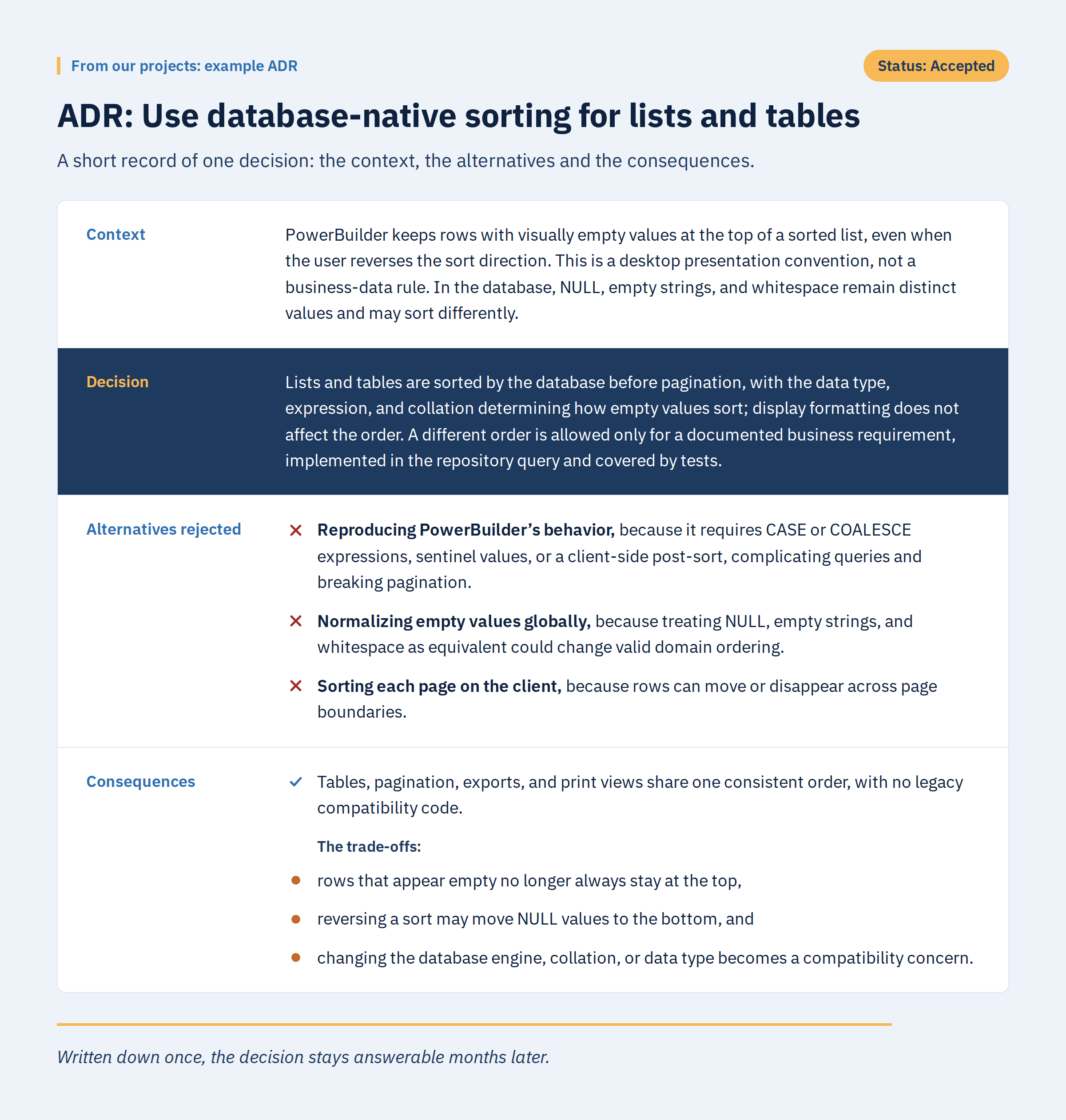
Give every business domain an owner. Technical modernization can't happen in an engineering vacuum. Each domain needs a Product Owner who checks that the migrated web application does what the legacy code was meant to do. Engineers can read the code, but the intent behind it lives in the business.
Keep new features out of the migration. Every request for net-new functionality goes to a separate backlog that opens after modernization. The migration team has one goal: feature parity. Say yes to "since you're in there" and every slice grows, every gate slips, and nobody can say when you will finish.
Treat risks like code. Technical, operational and staffing risks belong in an active, prioritized risk log, with a mitigation next to each entry. The delivery lead owns it, and the steering group reviews it. A risk that lives in one person's head is the same problem you are trying to get away from.
AI speeds up the analysis. It doesn't make the decisions
There's no shortage of promises that AI can now rewrite legacy software automatically, at a fraction of the old cost. For a system with decades of business rules spread across DataWindows, events and stored procedures, that isn't just optimistic. It's dangerous to plan around.
The useful question is a narrower one: where does automation save time, and where must a person decide?
AI helps where the work is reading and drafting. It can read millions of lines of PowerBuilder source far faster than any team. It can map dependencies and inheritance trees from PBL exports and turn them into graphs. It can generate boilerplate, such as API skeletons and unit test stubs, and draft documentation of what an old script does.
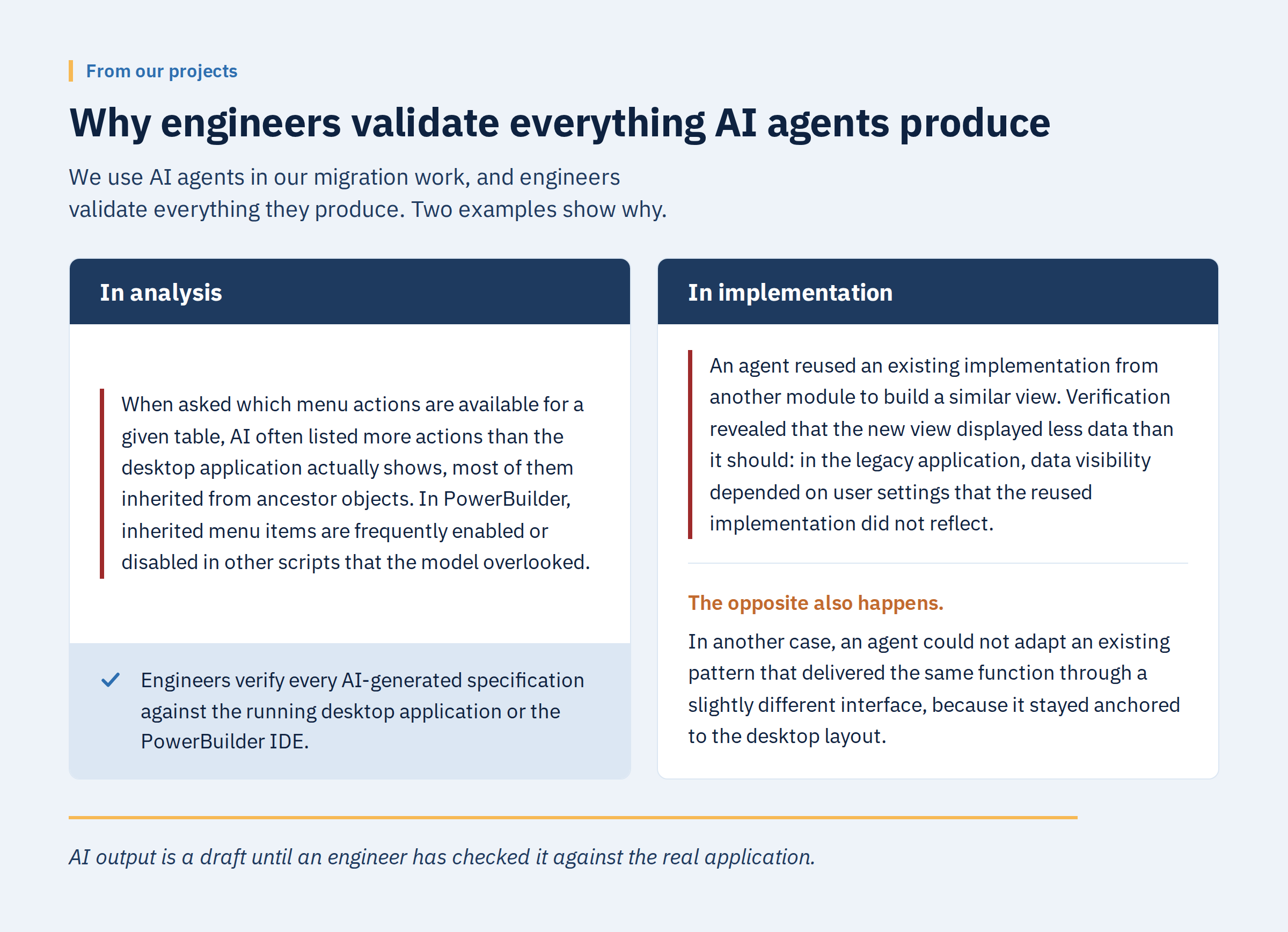
AI output is a draft until an engineer has checked it against the real application.
People decide where the work is judgment. Why a calculation works the way it does under today's regulations. Where the data coexistence boundaries and API gateway rules go. How rollback works. Whether the new web tier meets your security, compliance and data residency requirements. No model can answer these for you.
Used inside a structured engineering process, with experienced architects checking the output, AI is a strong accelerator. As a replacement for domain expertise, it's a reliable way to fail.

A credible assessment gives you eight things you can act on
Many leaders put off modernization because they fear unpredictable costs and timelines. That fear usually comes from planning with rough guesses or manual code reading. You can't scope a mission-critical application on a whiteboard.
A real assessment is an engineering deep-dive, not a survey or an automated marketing report. It analyzes the actual source code, database structures and runtime data. At the end, you should hold eight deliverables.
A business criticality map. It links windows and data workflows to the business units that depend on them.
A technical risk profile. A health check that points to code rot, obsolete object classes, hardcoded logic flaws and active vulnerabilities.
An automated dependency graph. It shows how PBL files, controls, user objects and database schemas connect. This is where the twelve areas from Part 2 get answered with data instead of memory.
A knowledge and documentation gap analysis. It shows where operations depend on the tribal knowledge of engineers who are close to retirement, the risk we described in Part 1.
Evaluated modernization paths. Your core modules mapped against the seven paths from Part 2, with the trade-offs spelled out.
A pilot slice recommendation. A concrete candidate for the first vertical slice, checked against the criteria from Part 3.
A phased roadmap with effort and risk bands. Ranges of cost and complexity backed by data, in place of single-number guesses.
Governance guidance tailored to your program. The control loops, steering cadence and change-management rules from this article, set up for your organization.
With these in hand, your team doesn't write a single line of web code until the target architecture is validated, the migration risks are mapped and the continuity controls are in place.
So here is a question to take back to your team: if a key technical decision from last year were questioned today, could you show who made it, what the alternatives were and why you chose this one? If the answer is "not really", governance is the first thing to fix.
Frequently asked questions
What should a PowerBuilder modernization governance model include?
A steering group that meets every two weeks, written Architecture Decision Records, a Product Owner for each business domain, a firm line against new features during migration and an active risk log. Together they protect the program from scope creep and architectural drift.
What is an Architecture Decision Record (ADR)?
It's a short record of a technical decision: the context, the alternatives considered, the choice and its consequences. Records aren't rewritten, so a changed decision gets a new one.
Where does AI help in PowerBuilder modernization, and where doesn't it?
It speeds up code reading, dependency mapping, boilerplate and tests, and draft documentation. People decide on business intent, coexistence boundaries, rollback and security, and engineers verify everything AI produces.
What should a modernization assessment deliver?
Eight things: a business criticality map, a technical risk profile, a dependency graph, a knowledge gap analysis, evaluated path options, a pilot slice recommendation, a phased roadmap with effort and risk bands and tailored governance guidance.
In Part 5, we look at the warning signs that your current model has stopped being sustainable, and at a three-stage way to start without an all-or-nothing contract.