A Faster, AI-Native Way to Build Web & Mobile Software
You don't need a total system overhaul to work at the speed of AI. We embed AI-native engineering directly into your tech stack – upgrading how software is built, not just what gets delivered.
Faster from discovery to first production commit — measured across internal projects vs. traditional delivery timelines.

Higher feature throughput per sprint compared to equivalent-complexity projects using traditional engineering.

Faster legacy modernization with AI-assisted analysis vs. manual codebase archaeology — industry benchmark, 2026.

Downtime. Every project delivered with full continuity — no big-bang migrations, no operational disruption.

The world changed.
Most vendors didn't.
Traditional software delivery was designed for a world where writing code was the most expensive part. That world no longer exists. We rebuilt our process from the ground up —for both new digital products and existing legacy ecosystems.

Primary Bottleneck:
Writing every line manually. Large teams, slow ramp-up, months before first commit.
Developer role:
Writing lines of code and managing tickets assigned from above.
Value of code:
High asset — every file costs real time and money to produce by hand.
Time to market:
Months to first working version. Years to full scale. Risk compounds with time.
Quality gates:
Manual QA phases at the end of cycles. Regressions are common and expensive to fix late.
Existing systems:
Full rewrite required to introduce AI. High risk, long timelines, business logic gets lost.
Team structure:
Large, resource-heavy teams with specialised silos. Coordination overhead grows with headcount.

Precise specification and QA. Small elite teams move faster because code is no longer the constraint.
Developers are architects and PMs of agents. Engineers own outcomes and systems — not implementation tasks.
Code is a Commodity. The value is in system design and business logic — not in keystrokes.
Production-ready delivery in first weeks. Scale starts from sprint one, not sprint twenty.
Quality through continuous AI-driven review on every commit.Quality is structural, not a phase you can skip.
AI-native processes layered directly onto existing infrastructure.
No rewrite, no regression risk, no downtime.
Small, senior, highly autonomous teams. Agents handle the scale; humans handle the judgment.
AI-Native Engineering for Greenfield & Core Systems
Two targeted paths to AI-native velocity. One engineering team that delivers both.
Build new products
the AI-native way
FFor teams building new products or major feature suites. We embed AI directly into the engineering workflow from day one—delivering superior architecture, faster velocity, and total transparency.
- Agentic-first architecture designed for AI collaboration
- Autonomous agents for implementation, testing, and review
- Small, senior engineering teams with measurable delivery velocity
- Automated code reviews and continuous QA guardrails
- Production-ready systems in weeks, not months
- Full engineer accountability on every commit
Upgrade how your legacy
system is developed
For teams with core systems that cannot stop or risk a full rewrite. We integrate AI-native processes directly into your existing architecture—accelerating delivery with zero regression risk.
- AI-assisted codebase analysis and dependency mapping
- Incremental AI integration into your active development workflow
- Automated test suite generation for untested legacy code
- Phased execution—each step proves value before the next begins
- Total code ownership with a cleaner, highly maintainable system
.webp)
Whether you’re building from scratch or evolving a decade-old system, the destination is the same: software delivered faster, with uncompromised quality, by a team that owns the outcome.
The RST delivery process:
Built for legacy. Proven in production.
Engineered for high-complexity legacy environments, our process eliminates execution risks through continuous, production-proven delivery.
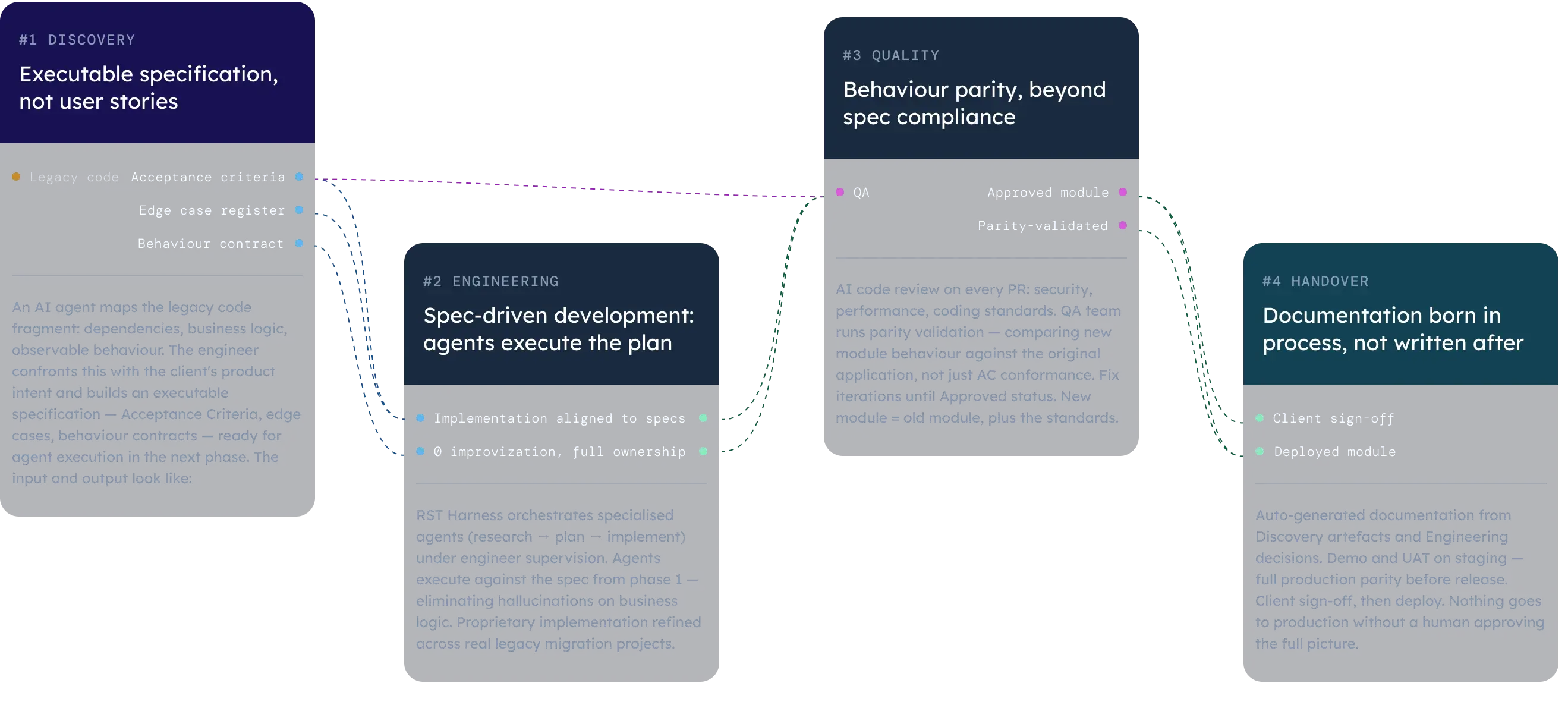
Executable specification, not user stories
An AI agent maps the legacy code fragment: dependencies, business logic, observable behaviour. The engineer confronts this with the client's product intent and builds an executable specification — Acceptance Criteria, edge cases, behaviour contracts — ready for agent execution in the next phase. The input and output look like:
Spec-driven development: agents execute the plan
RST Harness orchestrates specialised agents (research → plan → implement) under engineer supervision. Agents execute against the spec from phase 1 — eliminating hallucinations on business logic. Proprietary implementation refined across real legacy migration projects.
Behaviour parity, beyond spec compliance
AI code review on every PR: security, performance, coding standards. QA team runs parity validation — comparing new module behaviour against the original application, not just AC conformance. Fix iterations until Approved status. New module = old module, plus the standards.
Documentation born in process, not written after
Auto-generated documentation from Discovery artefacts and Engineering decisions. Demo and UAT on staging — full production parity before release. Client sign-off, then deploy. Nothing goes to production without a human approving the full picture.

Sharpening the harness
We turn project retrospectives into permanent engineering capabilities. After every slice, real-world execution data feeds back into the RST Harness knowledge base—refining agent instructions and expanding custom tooling. As a result, your delivery process gets measurably faster and more accurate with every iteration.
Agents execute.
Engineers decide.
Every phase maintains strict human oversight and outcome accountability.
Knowledge base
The harness is enriched with fresh domain context after every delivery slice.
Agent refinement
Missing tools are built immediately while prompt instructions are sharpened.
Compound effect
Every completed project permanently elevates delivery speed for all future work.
Dependency graph, business logic extraction, observable behaviour
Product intent alignment → executable spec, AC, behaviour contracts
Human-owned step
Context gathering, pattern matching, codebase analysis
Task decomposition, risk surfacing, spec alignment check
Spec-driven execution — zero deviation from defined business logic
Engineer supervises orchestration, resolves ambiguities
Agent-executed step
Human-owned step
Security, performance, and coding standards on every PR
New module behavior vs. legacy app — strict functional parity
Automated remediation loop until approved — zero parity compromises
Automated quality gate
Human-owned step
Generated continuously from Discovery artifacts and Engineering decisions
Full production parity — formal client sign-off before deployment
Automated CI/CD pipeline, regression guardrails, active observability
Continuous improvement loop
Human-owned step
Production & observability
Retrospective learnings → knowledge base and agent context enrichment
Slice N+1 executes with higher accuracy and speed than Slice N
Continuous improvement loop
Production & observability
Human-owned step
Agent-executed step
Automated quality gate
Production & observability
Continuous improvement loop
.webp)
Concrete Outcomes,
not Promises
Production-Ready Value in Weeks, Not Months
Eliminate long delivery cycles. Our framework ships a fully validated, production-ready release in weeks—whether building a new product from scratch or integrating AI-native workflows into an existing enterprise codebase.
Zero Full Rewrites. Zero Regression Risk.
We integrate AI-native engineering incrementally into your active software ecosystem. Continuous automated test generation guarantees that every iteration protects mission-critical stability.
100% Code Ownership & Zero Vendor Lock-In
Living documentation is generated continuously as we build. At every milestone, your internal engineering team receives total context and architectural sovereignty to maintain the system independently.
Measurable Delivery Velocity from Sprint One
Success metrics are established before kickoff. Track delivery throughput, quality gate pass rates, and cycle lead times in real time from day one—giving you complete operational transparency.
You Don't Just Modernize.
You Upgrade.
Full rewrites fail because they treat modernization as a single risky event. We treat it as an incremental, continuous process—validated at every step to deliver immediate business value.
Assessment
We analyze the codebase to map architectural dependencies, complexity hotspots, and embedded business logic. You receive a complete, data-backed architectural blueprint before a single line of code is modified.
Pilot Module
A single isolated module is modernized using AI-native processes, complete with automated test suites and real-time regression monitoring. This delivers tangible proof of speed and quality directly within your live system codebase.
Phased Rollout
System-wide modernization driven by AI-assisted refactoring, structural dependency decoupling, and continuous test coverage. Zero operational disruption—your production system remains fully active throughout execution.
Adoption
Your internal engineering team receives living documentation, complete architectural context, and continuous quality tooling to maintain the system with total independence. The new AI-native development standard stays permanently with your organization.




Frequently Asked Questions
The Harness is RST's AI-native delivery process built around five stages — Discovery, Engineering, Quality, Handover, and Evolve — where specialized agents (such as a Legacy Mapping Agent, Research Agent, Plan Agent, and Implement Agent) execute defined tasks while engineers supervise orchestration and own every outcome.
Measured across internal projects, RST's AI-native engineering is up to 70% faster from discovery to first production commit, delivers 2x higher feature throughput per sprint, and accelerates legacy modernization 3–5x compared to manual approaches — with zero downtime during delivery.
Agents execute — handling research, task decomposition, and spec-driven implementation — while engineers decide, supervising orchestration, resolving ambiguities, and maintaining outcome accountability at every phase. Every AI-generated output is reviewed by engineers before it moves forward.
Yes. RST offers two paths on one engineering team: greenfield development for new products built AI-native from day one, and legacy modernization that layers AI-native processes directly onto existing infrastructure — with no rewrite, no regression risk, and no downtime.
The Assessment phase typically takes 2–4 weeks and analyzes the codebase to map architectural dependencies, complexity hotspots, and embedded business logic, delivering a complete, data-backed architectural blueprint before any code is modified.